 Revenue
Short answer: to get more outdoor living projects, stop renting leads and build your own pipeline. Show your finished projects to homeowners in your area with Facebook and Instagram ads, qualify them with a short form, call them within minutes, follow up on every estimate, and track each lead to a signed contract in a CRM. Keep your Google Business Profile and reviews strong so homeowners who check you out find a busy, trusted contractor.
Why lead sites make it harder to grow
On Angi, a "Market Match" request goes to up to four pros (Angi Leads FAQ, archived Nov 2023). So you pay for a lead that three other contractors are also calling, and the homeowner compares you on price before they've seen your work. Lead sites can fill a slow week. They don't build anything you own: no audience, no data, no reputation in your area. More on this in Angi and HomeAdvisor vs Facebook ads.
What owning your pipeline looks like in real numbers
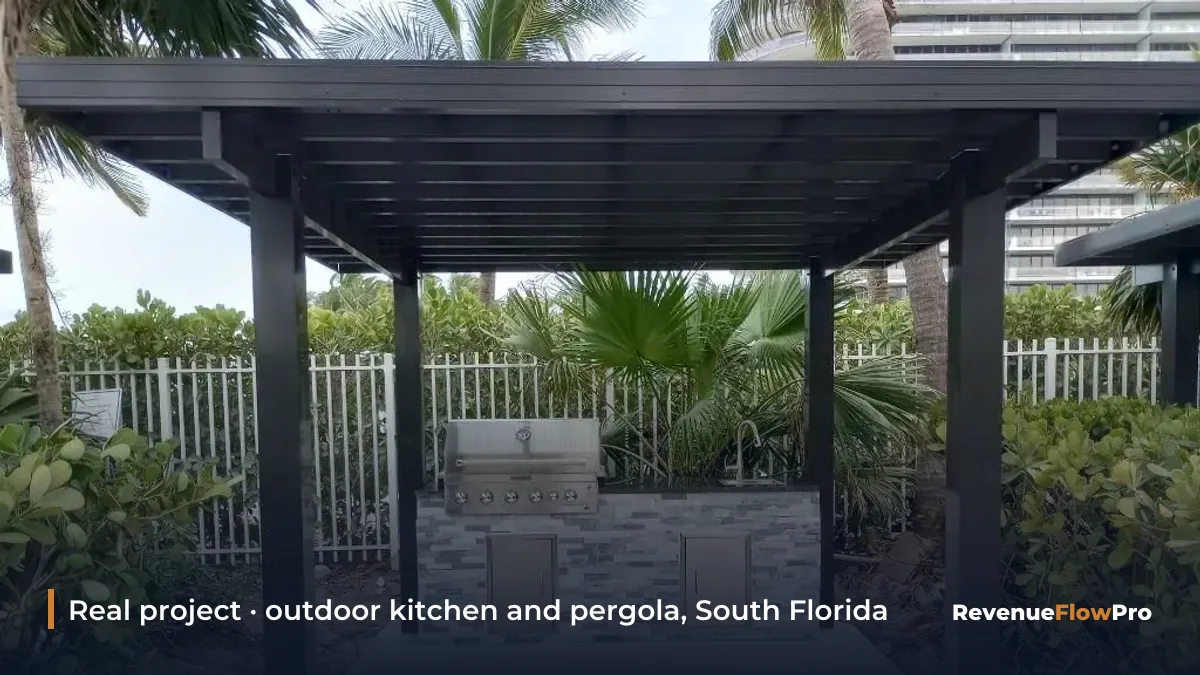
In & Out Construction, a pergola, patio cover and outdoor kitchen contractor in South Florida, runs on its own Meta ads instead of lead sites. In 2026:
| Measure | In & Out Construction, 2026 |
|---|---|
| Meta ad spend (Jan–Oct) | $18,688 (under $1,900 a month) |
| Opportunities in the CRM | 682, 98% from Facebook and Instagram |
| Estimates given | 231, worth $8.84M |
| Contracted | 11 projects, $419k (average $38k), 5% of estimates |
| Still pending (as of Nov 13, 2026) | 72 estimates, $2.12M (31% of estimates) |
| Ad spend per contracted project | about $1,700 |
After 10 months, for every project signed, about six more estimates were still open. Those 72 pending estimates were worth five times what had been contracted, which is why step 6 below matters as much as the ads.
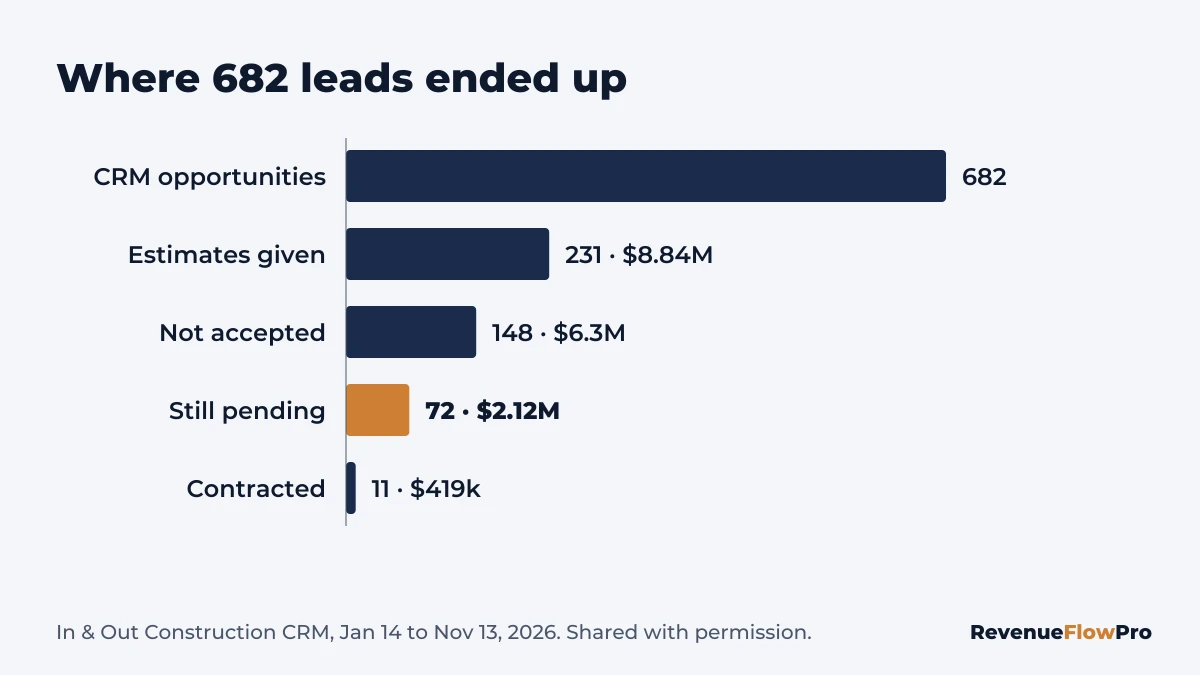
Source: the client's CRM (January 14 to November 13, 2026) and Meta account (spend January 1 to October 28), shared with permission. One contractor in one market: not a promise of results. Full funnel on the outdoor living lead benchmarks page.
For comparison, the published Meta average for home and home improvement leads is $42.95 per lead (WordStream/LocaliQ, 2026). Every one of those leads went to one contractor only.
Seven steps to more outdoor living projects
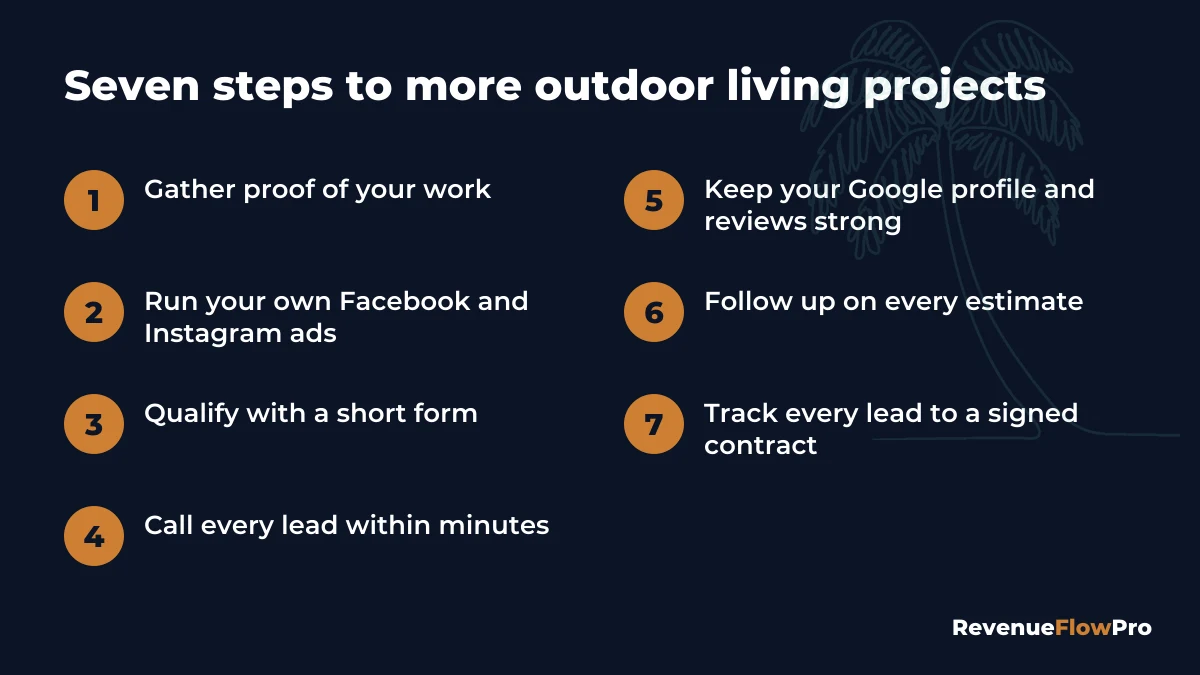
- Gather proof of your work. Photos and short clips of finished pergolas, patio covers and outdoor kitchens are your best sales tool. You don't need a film crew: in In & Out Construction's account, video ads made from project photos brought in 89% of leads (677 of 763) at about $25 per lead, against about $35 for image ads. See video ads from project photos.
- Run your own Facebook and Instagram ads in your service area. Homeowners plan backyard projects for weeks. Ads put your finished work in front of them while they plan, before they start searching for quotes. Demand is there: 54% of renovating homeowners took on outdoor projects in 2025 (2026 U.S. Houzz & Home Study).
- Qualify with a short form. Ask project type, timeline, budget range, homeowner status and area. Meta's "higher intent" form type adds a review step before submitting, which trades some volume for better leads (Meta lead ads documentation). Our list of questions is in what your lead form should ask.
- Call every lead within minutes. Firms that contacted a web lead within an hour were nearly 7 times more likely to qualify it than firms that waited longer (Harvard Business Review). Instant alerts and an automatic first reply make this possible on a busy job site. See speed to lead.
- Keep your Google Business Profile and reviews strong. Homeowners who see your ad will look you up. Google says local results are based mainly on relevance, distance and prominence, and that review count and rating count toward prominence (Google Business Profile Help). Only 4% of consumers say they never read online reviews of local businesses (BrightLocal Local Consumer Review Survey 2025). Ask every happy customer for a review, and never buy or filter them.
- Follow up on every estimate. This is where most of the money sits. In In & Out Construction's CRM, 72 estimates worth $2.12M were still pending on November 13, 2026, 10 months in. A set follow-up routine (a call after the site visit, a check-in after the quote, and a reminder before the season) wins projects you've already paid to find.
- Track every lead to the outcome. Put every lead in a CRM with clear stages: new, contacted, site visit booked, estimate sent, contracted, lost. Then judge your marketing on cost per contracted project, not cost per lead. The ROI calculator shows how many projects a month you need for the ads to pay.
What you need before you start
- Photos or video of at least a handful of finished projects.
- Room in your schedule for site visits and someone who answers new leads fast.
- A CRM, even a simple one, that everyone on the team uses.
- Usually $2,000 or more a month in ad spend, paid directly to Meta, to test properly.
How RevenueFlowPro does it
We build this whole pipeline for outdoor living contractors in Florida, Texas and Arizona: video ads from your real projects, qualifying forms, a CRM with instant alerts and follow-up, and monthly work on what's converting. We judge it on site visits, estimates and contracted revenue, and you see the same numbers in your own CRM. We work with one contractor per territory. See how we work or check whether your area is open.