 Revenue
Short answer: the best lead form questions are four or five quick multiple-choice ones (project type, timeline, budget range, whether they own the home, and their area) plus name, phone and email. That's enough to qualify a lead without putting people off.
Five lead form questions that work
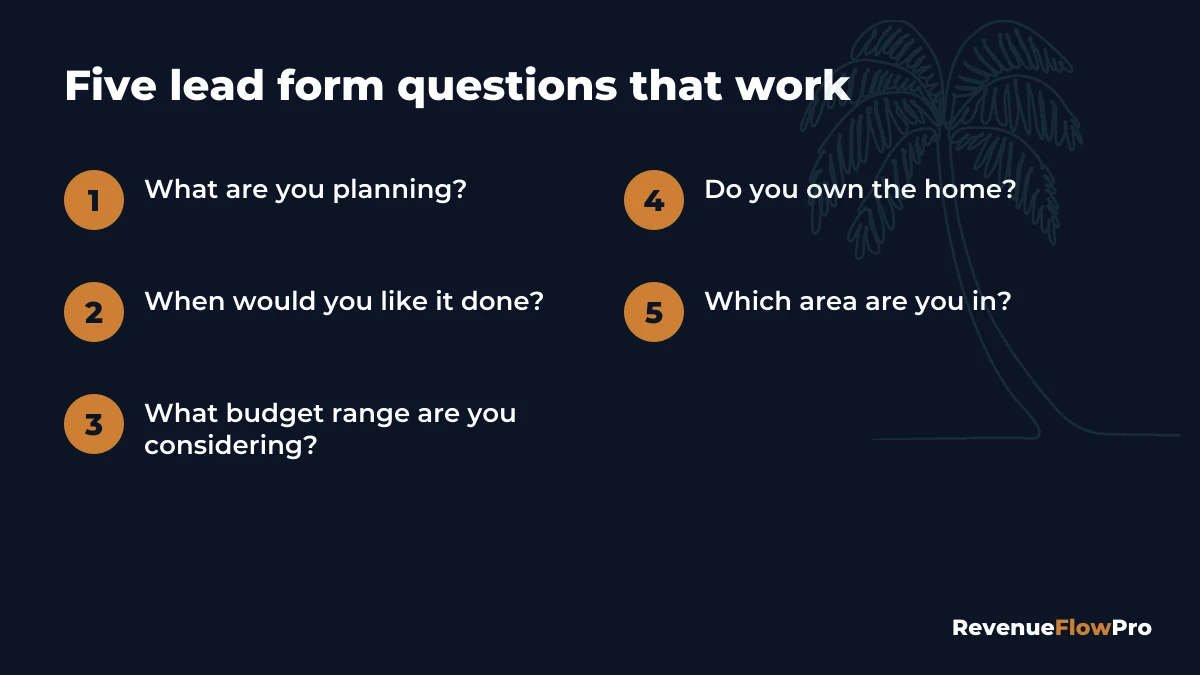
- What are you planning? Pergola / patio cover · Outdoor kitchen · Full backyard · Other
- When would you like it done? Within 3 months · 3–6 months · Just researching
- What budget range are you considering? Bands that match your real prices, with a "not sure" option
- Do you own the home? Yes · No
- Which area are you in? Your service areas, plus "Other"
Why multiple choice
Typed answers slow people down on a phone. Tap-to-answer questions keep completion high and give you clean data to sort leads automatically in your CRM: a homeowner planning a pergola within 3 months goes to the top of the list.
The research points the same way. HubSpot's analysis of over 40,000 landing pages found that multiple large text boxes have a strong negative effect on conversion rates (HubSpot), and on mobile, dropdowns take more taps and hide the choices (CXL). Meta's instant forms support custom multiple-choice questions, so every answer is a tap (Meta lead ads documentation).
Use the "higher intent" form type
Meta's higher-intent forms add a review step before submitting. You'll get slightly fewer leads, but more of them are real, which matters more than volume when your team has to call every one.
What to do with the answers
Map each answer to a field in your CRM. Then the system can sort leads for you: hot (planning within 3 months, budget fits, homeowner, in your area) gets called first; "just researching" goes into a longer email follow-up instead of being forgotten. Keep the lead form questions the same across ads so you can compare which ads bring in the leads that book estimates.
Mistakes that cost you leads
- Asking for an address on the form. It feels like a commitment this early. Ask for the area, and get the address when you book the site visit.
- Open text boxes ("Tell us about your project"). Few people type much on a phone; save that for the call.
- Budget bands that don't match your prices. If your smallest pergola starts well above the lowest band, that band only brings in leads you can't serve.
- Changing the form every week. You lose the ability to compare ads on the leads that actually book.
Don't stop at the form
The form is only the first step. What happens in the next five minutes decides whether that lead books an estimate: see speed to lead for contractors. To see what these leads cost in a real account, read what pergola leads cost on Meta.